


Amelia Earhart, Fashion Designer
by Ainsley Smith
Amelia Earhart is known for her accolades in aviation, but she was also interested in fashion and its functions in different environments. As an active and modern woman, Amelia found much of women’s clothing impractical and restrictive, and as a pilot, she recognized that flight clothes were bulky and ill-proportioned for a woman, as they were made solely for men. Amelia’s interest in fashion was characterized by an interest in activities and how the clothes one wears can help or hinder progress.

In her first book, 20 Hrs. 40 Min., Amelia often describes what she wore while flying across the Atlantic. She explains, “I think two questions have been asked me most frequently. First: Was I afraid? Secondly: What did I wear? … Perhaps the second question may be thought feminine, but I have had as many men as women appear interested (1).” She notes that men and women should both consider the function of their clothing, and that fashion is not a strictly feminine subject to find interest in. As both pilot and passenger, the functionality of clothes was of utmost importance; one needs to consider weather conditions, weight, and the length of the flight. Amelia writes that for short flights she wore “every-day clothes– what one would use for street wear or sports,” but the Friendship flight was different (2). For this long journey, she wore breeks “because of the jump from the pontoon to the door and … slipping on and off the flying suit,” as well as “old flying clothes, comfortably, if not elegantly, battered and worn (3).” When she describes this uniform– boots, breeks, blouse, sweater, leather coat, leather flying helmet, and goggles– she uses words like “old,” “antiquated,” “ancient,” and “homely”, focusing solely on their functionality, comfortability, and modest look. However, her interest in fashion is illustrated in the inclusion of her final accessory: “A single elegance was a brown and white silk scarf (4).”

In the Friendship flight, the public had a very different perception of Amelia’s role in the flight than she had, and their reception of her vs. her male counterparts upon landing surprised her. Amelia writes that from the beginning she tried to show them “that all the credit belonged to the boys, who did the work,” but the sensationalism of a woman crossing the Atlantic– even without doing any of the flying– made her “the chief performer in our particular sideshow (5).” Amelia comments on assumptions made about her fashion choices, due to her sex, writing, “There seems to be a feeling that a woman preparing to drop in on England, so to speak, ought to have something of a wardrobe. However, I chose to take with me only what I had on. The men on the Friendship took no ‘extras (6).’” Amelia writes about the importance of functionality over frivolity in this specific environment, explaining, “When it was cold I wore– as did the men– a heavy fur-lined flying suit which covers one completely from head to toe (7).” Her suit and the men’s suits were truly comparable, as she had to borrow a men’s suit from her friend Major Charles H. Woolley of Boston (8). She jokes that the suit was big enough “to lose myself in it” as a size 40, but even through humor, Amelia illuminates the issue of male domination in the aviation field (9). She points out that not only are flight clothes made with men in mind, but “Equipment too is naturally designed for men– for instance, there is no parachute really adequate for women. Woman is conscious that she is intruding–or something akin to that–a feeling which causes hesitation (10).”
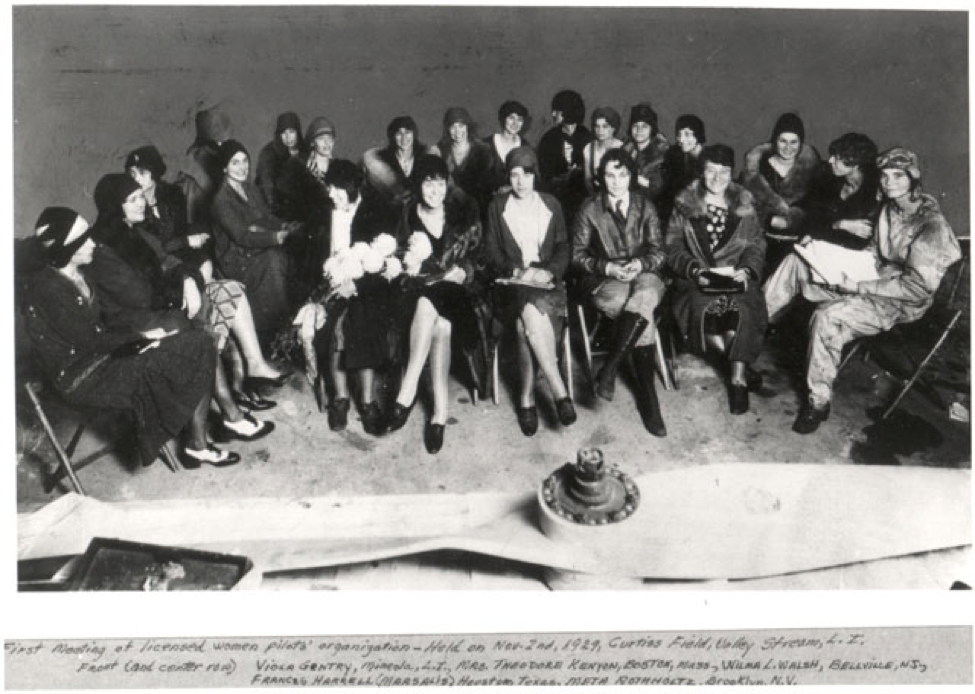
As first president of the women pilots’ organization the Ninety-Nines, and unwilling to be excluded in her own field, Amelia designed a flying suit specifically for women: “Women pilots had a lot of trouble getting practical clothes to wear flying. We had to buy men’s clothes, or special models made up by stylists, and they were seldom really useful or appropriate besides being too expensive (11).” After the flying suit, Amelia was inspired to create her own fashion line– a sports line with the intention to create clothing that was functional as well as beautiful. She used materials like lastex, parachute silk, and airplane cloth to incorporate her love of flying and make her designs flexible, durable and weather-proof, explaining that her designs were “nothing exciting – just good lines and good materials for women who lead active lives (12).” One such product that demonstrates Amelia’s aviation-inspired designs, and harkens back to her notion of “a single elegance” in a flight uniform, is a scarf on display at the Amelia Earhart Birthplace Museum; its pattern depicts an airplane-and-cloud design, perfect for an aviatrix.
Amelia’s primary interest in designing clothing was to make it more accessible to the modern woman. She thought of activity levels, declaring that “Modern women are strenuously active … most of their daylight hours are spent in activity, whether they be business women, debutantes, or matrons,” and because of this activity, women needed more flexible and breathable clothing (13). Amelia also considered the range of women’s body types and made her line accommodate that diversity: “I have spent some time thinking of those quantities of female phenomena whose figures don’t conform to any standard known to man or sage! So I made two-piece dresses with provision for scrambling. If a woman wants a 16 skirt and a 14 blouse, she can have it, as far as my clothes are concerned (14).”
The AE line was unique, progressive, and considerate of women’s needs, but unfortunately, it was short-lived. Despite Amelia’s goal of producing affordable designer fashions, she was committed to using unique materials which did not produce a major profit, and her line only lasted one season (15)
. Although she did not create a long-lasting line of clothing products, Amelia brought more attention to the cause for versatile and stylish women’s fashion. Amelia was an advocate for female empowerment in all areas of life, and her short investment in fashion added momentum to the long process of producing clothes that make women feel comfortable and confident in themselves.
Endnotes
Amelia Earhart. "Preparations," 20 Hrs. 40 Min.: Our Flight in the Friendship, 47.
Earhart, 48.
Ibid.
Ibid.
Earhart, 115.
Earhart, 48.
Earhart, 49.
Ibid.
Earhart, 104.
Earhart, 140.
Barbara H. Schultz. "Fashion," Endorsed by Earhart, 59.
Ibid.
Schultz, 60.
Ibid.
Schultz, 61.
Bibliography
Earhart, Amelia. 20 Hrs. 40 Min.: Our Flight in the Friendship. Mansfield Centre, CT: Martino Publishing, 2014.
Schultz, Barbara H. “Fashion.” Endorsed by Earhart, 58–63. Lancaster, CA: Little Buttes Publishing Co, 2014.


Great post! I appreciate the useful insights.